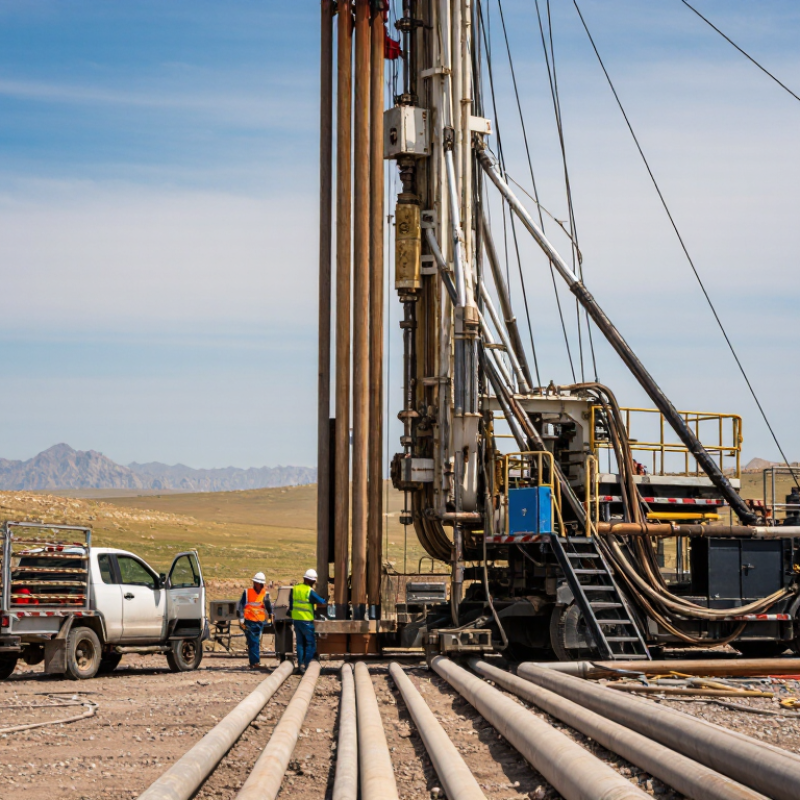
| Product Portfolio and Application Coverage | 15% | Availability of land rigs, truck-mounted rigs, crawler rigs, rotary tables, top drives, drawworks, mud pumps, hoisting systems, drill pipes, and auxiliary equipment. | A strong global supplier should provide equipment suited to the intended application, including water wells, geotechnical drilling, mining, geothermal drilling, or oil and gas operations. Product specifications should clearly state depth capability, torque, pullback force, pump capacity, and operating limits. | 0–10 points |
| Technical Performance | 15% | Rated drilling depth, maximum torque, rotary speed, hook load, pullback force, mast capacity, mud-pump pressure, and power configuration. | Compare equipment under the same drilling method, formation conditions, borehole diameter, depth range, and duty cycle. Avoid comparing headline specifications without checking continuous operating ratings. | 0–10 points |
| Compliance with International Standards | 15% | Applicable conformity documents, inspection records, material certificates, welding qualifications, pressure-test records, and certificates for safety-critical components. | For relevant oilfield equipment, verify applicable API and ISO requirements, such as API Spec 4F for drilling and well-servicing structures, API Spec 7K for drilling and well-servicing equipment, and API Spec 8C for hoisting equipment. Electrical systems may also require IECEx or ATEX compliance where hazardous-area operation applies. | 0–10 points |
| Quality Management System | 10% | Valid quality-management certification, production-control procedures, incoming inspection, nonconformance management, traceability, and final inspection records. | A certified ISO 9001 quality-management system is a useful baseline, but it should be supported by product-specific inspection plans and traceability for pressure-bearing, lifting, rotating, and structural components. | 0–10 points |
| Safety and Risk Control | 12% | Emergency-stop systems, guards, interlocks, blowout-prevention interfaces where applicable, load-monitoring systems, hydraulic protection, operator-access controls, and safety manuals. | The equipment should include documented risk assessments, clearly marked safe working loads, emergency procedures, maintenance intervals, and protection against foreseeable mechanical, hydraulic, electrical, and pressure-related hazards. | 0–10 points |
| Reliability and Service Life | 10% | Operating references, equipment uptime data, preventive-maintenance requirements, mean time between failures where available, critical spare-parts history, and component service intervals. | Prioritize documented field performance in drilling environments similar to the buyer’s application. Reliability claims should be supported by verifiable customer references, inspection records, or operating histories rather than promotional statements alone. | 0–10 points |
| After-Sales Support and Spare Parts | 10% | Regional service coverage, response-time commitments, spare-parts availability, remote diagnostics, field technicians, training, commissioning, and warranty terms. | A competitive supplier should provide technical documentation, recommended spare-parts lists, parts identification, troubleshooting support, and a defined process for warranty and emergency service. | 0–10 points |
| Customization and Integration Capability | 8% | Ability to adapt chassis, mast height, drilling package, power source, control system, mud system, automation level, and environmental protection. | Customization should be based on documented engineering calculations, interface drawings, load cases, hydraulic and electrical schematics, and formal change-control procedures. | 0–10 points |
| Manufacturing Capacity and Delivery Control | 8% | Production facilities, testing equipment, manufacturing lead time, project-management process, supply-chain resilience, and factory-acceptance testing capability. | Assess whether the supplier can meet the required quantity, delivery schedule, inspection plan, packaging requirements, and export documentation without compromising quality or commissioning support. | 0–10 points |
| Total Cost of Ownership | 7% | Purchase price, transport, installation, commissioning, energy consumption, consumables, planned maintenance, spare parts, downtime exposure, and resale or residual value. | Select equipment using life-cycle cost rather than purchase price alone. A lower initial price may be outweighed by higher fuel consumption, shorter component life, limited parts availability, or extended downtime. | 0–10 points |