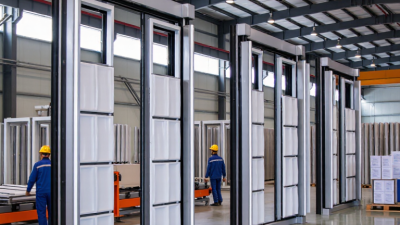
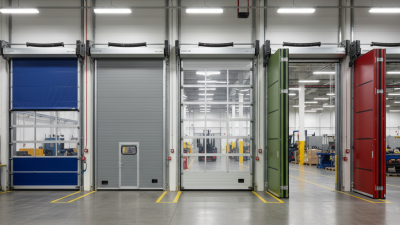
Choosing the best industrial overhead door from China requires more than comparing catalog prices. The decision begins with the building, traffic pattern, climate, and safety requirements. Measure the opening carefully. Record its width, height, headroom, side room, and daily operating cycles. A loading dock may need a high-cycle steel door, while a refrigerated room requires insulated panels and dependable seals.
Tom Wadsworth, a respected door-industry consultant and former DASMA technical director, has offered practical advice: “Choose the door for the application, not simply for its price.” That principle matters when evaluating Chinese manufacturers. Review material grades, panel thickness, track design, spring life, motor protection, control systems, and available replacement parts. Ask for test reports, installation drawings, maintenance schedules, and clear warranty terms. Verify whether the supplier can support your destination’s applicable safety and building requirements.
Look closely at small details. Does the bottom seal remain flexible in cold weather? Are hinges reinforced near busy traffic lanes? Can technicians replace a damaged panel without removing the entire assembly? Factory photos help, but they are not proof. Request samples, video inspections, and references from comparable projects. A spreadsheet cannot reveal every weakness.
I would also allow room for uncertainty. Shipping damage, unclear translations, or delayed spare parts can change the real cost. The cheapest quote may become expensive after installation. Choose a supplier that communicates precisely and admits limitations. A reliable industrial overhead door is not only strong on delivery day. It must open smoothly, protect workers, and keep performing after thousands of cycles. That is where careful judgment matters.
Defining requirements is the real starting point, not comparing catalog prices. A door should match your building, workflow, climate, and safety expectations. Begin with the opening width, height, available headroom, and side-room clearance. Measure twice. Small errors can delay installation and increase freight costs.
Describe daily operation in numbers. How many cycles will the door complete each day? Will forklifts pass through every few minutes? High traffic may require a faster door, stronger springs, and a reliable control system. Consider wind exposure, dust, humidity, temperature, and cleaning chemicals. A cold warehouse needs suitable seals and insulation. A food-handling area may need smooth, washable surfaces. Do not guess.
In my project experience, users often specify panel color before explaining traffic conditions. That choice rarely solves the main problem. Ask the Chinese manufacturer for drawings, material specifications, cycle ratings, safety features, and installation requirements. Request evidence for stated performance, such as test reports or inspection records. Confirm whether replacement panels, seals, rollers, and control parts remain available. Check electrical compatibility before ordering. A technically suitable door can still fail if local power conditions are ignored.
Leave space for honest review. Your first requirement list may be incomplete. Revisit it with the installer, maintenance team, and daily operators. Their practical comments can reveal blocked sensors, awkward manual release points, or poor drainage. These details often matter more than a polished quotation.
Industrial overhead doors from China should match the building, traffic, and maintenance team. Sectional doors suit warehouses needing insulation and controlled access. Rolling steel doors save ceiling space and handle frequent movement. High-speed fabric doors reduce air exchange, but they need a protected operating area. I have seen a poor choice cause long queues beside loading bays.
Materials change service life. Galvanized steel offers strength for busy docks and exposed walls. Aluminum weighs less and resists corrosion, although it may dent more easily. Insulated sandwich panels help stabilize indoor temperatures. Check panel thickness, seals, hinges, and bottom edges, not only the surface finish. A door can look impressive and still leak cold air around its perimeter.
Operating systems deserve equal attention. Chain drives are practical for moderate cycles and straightforward repairs. Direct-drive systems can feel smoother, but correct sizing remains essential. Choose push-button, pull-cord, remote, or sensor control according to traffic patterns. Add manual release access for power interruptions. Ask for cycle ratings, safety sensors, wiring diagrams, spare parts, and service training. Factory drawings and load calculations improve confidence, yet they do not replace a site inspection. Measure twice. My own mistake was trusting a standard opening size; the floor was uneven, and installation took longer than planned. Compare the complete cost, including freight, commissioning, maintenance, and replacement components.
| Door Type | Typical Applications | Main Materials | Insulation Performance | Typical Opening Speed | Operating Systems | Wind and Weather Performance | Maintenance Requirements | Key Advantages | Important Limitations |
|---|---|---|---|---|---|---|---|---|---|
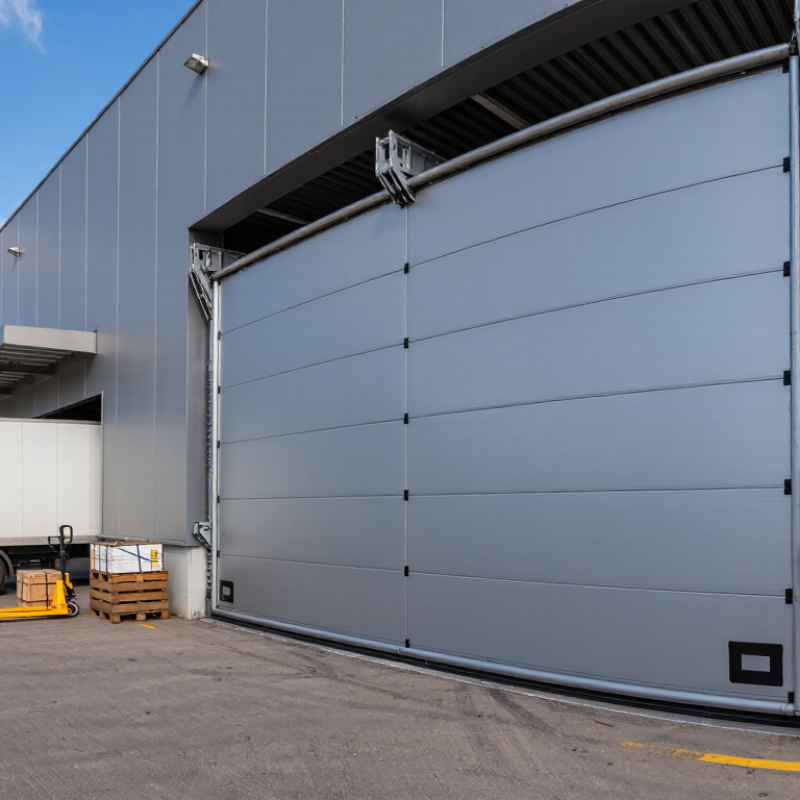
| Insulated Sectional Overhead Door | Factories, warehouses, logistics centers, workshops, and loading bays | Double-skin galvanized steel or aluminum panels with polyurethane foam core; EPDM seals and galvanized hardware | High. Panel thickness commonly ranges from 40 to 80 mm, with typical U-values of approximately 0.5–0.8 W/m²·K depending on construction | Approximately 0.2–0.4 m/s for standard systems | Chain hoist, jackshaft motor, trolley motor, or direct-drive motor; optional push-button, pull-cord, loop detector, radar, and remote control | Good when correctly specified; bottom seals, side seals, and panel reinforcement are important in exposed locations | Inspect rollers, hinges, cables, springs, seals, and safety devices at least every 3–6 months, depending on usage | Strong thermal performance, good security, flexible dimensions, and a wide range of vision-panel options | Requires ceiling or side-room clearance; springs, cables, and rollers need periodic inspection |
| Non-Insulated Rolling Steel Door | Storage areas, parking facilities, workshops, utility rooms, and internal separation openings | Galvanized steel slats, aluminum bottom bar, steel guides, and steel barrel assembly | Low. Single-skin slats provide limited thermal resistance | Approximately 0.15–0.3 m/s for standard motorized models | Manual chain hoist, tubular motor, jackshaft motor, or emergency hand chain | Good for basic weather protection; wind-lock guides may be required for wider or externally exposed doors | Check slat alignment, guides, barrel bearings, motor brake, bottom bar, and safety edge periodically | Compact overhead storage, simple construction, durable steel curtain, and generally low initial cost | Limited insulation and acoustic performance; slats can be noisy during operation |
| Insulated Rolling Steel Door | Cold-chain support areas, production buildings, warehouses, and exterior openings requiring thermal control | Double-wall galvanized steel or aluminum slats with polyurethane insulation and perimeter seals | Medium to high. Performance depends on slat profile, thickness, seals, and installation quality | Approximately 0.15–0.3 m/s | Jackshaft motor, chain hoist, control panel, photoelectric sensors, and optional automatic closing | Good to very good when wind-rated guides and properly sealed side jambs are used | Inspect slats, wind locks, guides, seals, motor, curtain balance, and safety controls | Space-efficient roll-up design with better thermal and weather performance than single-skin doors | Higher weight and cost than non-insulated rolling doors; damaged slats may require section replacement |
| High-Speed Fabric Roll-Up Door | High-traffic warehouses, food-processing areas, clean production zones, and internal logistics routes | PVC-coated polyester curtain, galvanized or stainless steel frame, flexible bottom beam, and aluminum or steel guides | Low to medium. It improves air separation but normally does not match insulated rigid-panel doors | Opening speeds commonly range from 0.8–2.0 m/s; closing speed depends on the control system | High-cycle geared motor, inverter or variable-frequency drive, radar, induction loop, photoelectric sensor, and safety edge | Suitable for controlled environments; wind resistance varies significantly by curtain design and guide system | Clean the curtain and sensors, inspect guides and bottom beam, and test safety devices frequently in high-cycle areas | Very fast traffic flow, reduced air exchange, lower energy loss, and minimized forklift waiting time | Not normally intended as the primary security barrier; fabric can be damaged by impact if repairable breakaway features are not used |
| High-Speed Rigid Panel Door | Exterior logistics openings, temperature-controlled warehouses, and high-frequency industrial traffic | Insulated aluminum or composite rigid panels, galvanized or stainless steel frame, and reinforced side guides | Medium to high, depending on panel thickness and perimeter sealing | Opening speeds commonly range from 1.0–2.5 m/s | Variable-frequency motor, encoder, radar, loop detector, photoelectric sensors, and programmable control panel | Generally better wind resistance and security than fabric high-speed doors, subject to tested door width and design | Inspect panels, guides, drive components, sensors, seals, and control parameters at scheduled intervals | Fast operation combined with better insulation, appearance, and exterior weather resistance | Higher purchase cost and more complex controls; installation and alignment must be precise |
| Fire-Rated Rolling Shutter | Fire compartments, industrial kitchens, warehouses, car parks, and openings requiring fire separation | Fire-resistant galvanized or stainless steel curtain, guides, fusible link or monitored release system, and fire-rated bottom bar | Usually low to medium; the primary function is fire compartmentation rather than thermal insulation | Typically slower than high-speed doors; closing speed is controlled to support safe fire performance | Motorized release system, fire alarm interface, gravity-assisted or controlled closing, emergency release, and monitoring devices | Good when the complete assembly is correctly tested, installed, and maintained for the required environment | Frequent inspection is essential; test release devices, guides, curtain condition, closing path, and fire-alarm interface | Provides compartmentation and automatic closure during a fire event when specified and maintained correctly | Must be selected according to the required fire-resistance classification and local code; not a substitute for a high-speed traffic door |
| Full-View Aluminum Overhead Door | Vehicle service centers, showrooms, aircraft facilities, fire stations, and commercial workshops | Aluminum frames with tempered glass, polycarbonate, or acrylic vision panels; galvanized hardware | Low to medium, depending on glazing type and thermal-break design | Approximately 0.2–0.4 m/s | Trolley motor, jackshaft motor, direct-drive motor, push-button control, and optional automatic sensors | Moderate to good when framed sections, glazing, seals, and reinforcement are correctly selected | Clean glazing, inspect panel connections, rollers, hinges, seals, cables, and safety devices | High visibility, attractive appearance, natural daylight, and improved supervision between work areas | Lower insulation and impact resistance than solid insulated panels; glazing may increase replacement cost |
| Manual Overhead Door | Low-frequency access points, small workshops, storage rooms, and locations without reliable power supply | Steel, aluminum, or composite panels with torsion springs, cables, rollers, and manual lifting hardware | Low to high depending on the selected panel construction | Operator-dependent; generally slower and less consistent than powered operation | Direct manual lift, pull rope, or chain hoist; no electrical control system required | Depends on door construction, locking system, seals, and structural anchoring | Inspect spring balance, cables, rollers, hinges, locks, and panel condition; never adjust springs without trained personnel | Low energy consumption, simple controls, and continued operation during power outages | Not suitable for high-cycle traffic or large, heavy doors; operator effort increases with door size and imbalance |
Note: Performance figures are typical industry ranges for comparison only. Final selection should be based on door size, cycle frequency, opening location, wind exposure, temperature requirements, fire regulations, available headroom, safety standards, and the manufacturer’s tested specifications.
China offers a deep industrial supply base, but scale does not guarantee door quality. UNIDO’s International Yearbook of Industrial Statistics 2024 places China at roughly one-third of global manufacturing value added. This creates choice, not certainty. A serious evaluation should begin with the factory’s actual production records. Ask for recent orders, material certificates, inspection plans, and batch traceability documents.
Product quality must be measured against your operating conditions. Check panel thickness, insulation performance, sealing pressure, spring balance, and control-panel protection. Request documented cycle testing, not verbal promises. ISO 9001 certification can show process discipline, but it cannot prove every door is well built. The ISO Survey reports China as one of the largest holders of ISO 9001 certificates worldwide. That is useful context, not a final decision.
Audit the details people often ignore. Watch how workers align tracks, tighten fasteners, and protect finished surfaces. Review nonconformance records and corrective actions. Test a production sample before approving bulk delivery. For logistics planning, the World Bank’s 2023 Logistics Performance Index ranked China 19th, with a score of 3.7. Delivery capability is strong, yet delays and packaging damage still happen. One weakness remains easy to miss: factories may present their best sample. Compare that sample with random units from a completed batch. A supplier that accepts independent inspection is usually easier to trust.
How to Choose the Best Industrial Overhead Door from China?
When sourcing an industrial overhead door from China, safety verification should come before price. Request the manufacturer’s current certificates, test reports, and laboratory details. Check whether these documents match the exact door model, motor, control system, and intended market. A certificate for one configuration may not cover another. Look for documented tests covering impact resistance, curtain strength, emergency release, electrical safety, and wind-load performance. Ask for serial numbers and production records. Traceability matters.
Tips: Request factory inspection photos, installation manuals, wiring diagrams, and maintenance schedules. Confirm that safety edges, photoelectric sensors, warning lights, and manual overrides are included. Ask how each part is tested before shipment. Short answers deserve deeper questions.
Customization should improve safety, not merely appearance. Confirm the opening dimensions, operating frequency, temperature range, insulation needs, and local wind conditions. Discuss panel thickness, sealing materials, traffic sensors, and control access with an engineer. A reputable supplier should explain limitations clearly. Be cautious when every request receives an immediate “yes.” That can indicate weak technical review. I would also test a sample or witness a factory inspection when possible. Small details, such as sensor alignment and emergency-release height, can affect daily reliability. The cheapest quotation may become expensive after installation changes, delayed parts, or unclear warranty responsibilities.
Verify safety standards, certifications, wind-load performance, and customization options before placing an order.
How to use this data
EN 12424 classifies industrial doors by wind-load resistance. Classes 1–4 correspond to minimum test pressures of 300, 450, 700, and 1,000 N/m². Ask the manufacturer for the test report and select the class according to the building location, opening size, local wind conditions, and door exposure.
Verification checklist
Choosing an industrial overhead door from China requires more than comparing catalog prices. A low quote can still become expensive. Request a detailed offer covering door panels, tracks, motors, controls, packing, and spare parts. Confirm whether taxes, export handling, and destination charges are included. Ask for drawings and written specifications before approving payment.
Logistics can affect the project schedule sharply. Check the packed dimensions, container loading plan, shipping term, and estimated transit time. Protective packaging matters, especially for painted panels and control cabinets. I would also request loading photos and a packing list. Small errors there can delay installation. Leave some schedule flexibility; port congestion and customs inspections are not fully predictable.
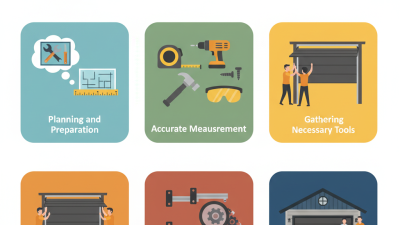
Installation quality influences safety and service life. Ask whether the supplier provides manuals, remote guidance, or a trained technician. The installer should verify the opening, floor level, electrical supply, wind conditions, and safety sensors. After-sales support needs clear response times, warranty limits, troubleshooting steps, and spare-part availability. Get these details in writing. A video call can test technical communication before purchase. Some suppliers answer quickly during sales but slowly after delivery. That gap deserves attention. My own review would include a maintenance schedule, although many buyers overlook it. Also, do not assume every local contractor understands industrial doors. Verify experience with the exact door structure and control system.

Since 1984, Thermostop has been a reputable manufacturer of Industrial Sectional Doors, Cold Storage Doors and Specialty Doors such as Impactable Breakaway doors, Acoustic Doors and Ballistic Doors.
Contact