Choosing the right steel garage door manufacturer in China requires more than comparing prices and attractive catalog images. Buyers must examine factory experience, material quality, engineering support, production capacity, and after-sales reliability. A dependable supplier should explain steel thickness, galvanized coatings, insulation options, spring systems, and surface protection in clear technical language.
This guide evaluates leading Chinese manufacturers through practical purchasing criteria. These include factory audits, product certifications, quality-control procedures, export experience, customization capabilities, and customer feedback. Details matter. A well-built steel garage door should open smoothly, resist weather exposure, and maintain stable performance after repeated cycles. Sample inspections can also reveal welding marks, panel alignment, seal quality, and hardware consistency.
Look beyond polished websites. Some manufacturers present impressive project photos but provide limited testing records or vague warranty terms. That deserves careful review. Our comparison considers how suppliers respond to technical questions, manage production changes, protect packaging, and support installation after delivery. It also recognizes that no factory is perfect; communication delays, inconsistent finishes, or unclear specifications may still occur. The strongest companies acknowledge these risks and offer practical solutions.
Readers will gain a clearer framework for comparing manufacturers by application, budget, climate, and project scale. Whether sourcing residential doors, commercial systems, or customized industrial solutions, reliable evidence should guide the final decision. A low quotation may look appealing. However, long-term performance, replacement support, and transparent documentation often matter more than the initial purchase price.
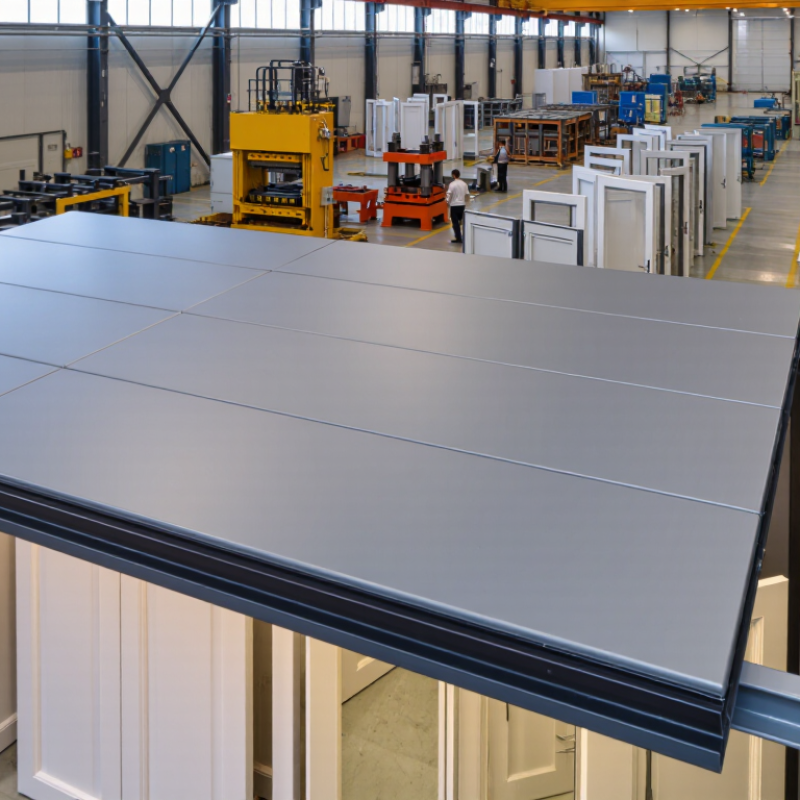
China’s steel garage door market remained export-oriented in 2024, supported by residential construction, replacement demand, and overseas distribution networks. Production indicators included factory capacity, monthly output, steel consumption, and automated coating lines. Export indicators focused on shipment volume, destination markets, container frequency, and compliance documentation.
The strongest manufacturers are usually identified by consistent production records, not attractive catalogs alone. Experienced factories can provide traceable steel grades, tested hardware, stable dimensions, and clear quality-control procedures. Export performance also matters. A reliable supplier should explain its 2024 shipment experience, packaging method, lead time, and after-sales process. Some market figures are difficult to compare because companies use different reporting standards. That weakness deserves attention.
Tips: Request recent production evidence, loading photos, inspection records, and sample specifications. Check whether the quoted door thickness matches the delivered product. Ask about salt-spray testing for coastal projects. A small sample order can reveal welding quality, surface finish, and communication speed before larger purchasing decisions. Also review export documents carefully, since a low price may hide incomplete accessories or higher installation costs.
What Are the Top Steel Garage Door Manufacturers in China?
The strongest manufacturers should be judged by measurable construction, not showroom appearance. I would start with 24–26 gauge steel panels, because thicker 24-gauge steel usually resists dents better than 26-gauge material. However, steel gauge alone does not prove long-term quality. Panel bracing, galvanized coatings, seals, and hinge design also matter.
Insulation deserves close inspection. A reliable door should provide an independently supported R-12 to R-18 rating, with clear testing details. Ask whether the rating applies to the complete door or only the foam core. That difference can be significant. Manufacturers should also document a 10,000-cycle minimum for springs, rollers, and moving hardware. Cycle claims may depend on correct installation and balanced door weight. A perfect ranking is impossible. Factory data can look strong, while field performance varies.
Tips: Request sample panels, test reports, cycle specifications, and warranty terms before comparing prices. Check the door after repeated operation. Listen for scraping, vibration, or uneven movement. My practical preference is a manufacturer that explains limitations honestly, not one promising unlimited durability. Installation support, replacement-part access, and response time are useful signs of reliability. These details often reveal more than polished catalogs.
This reference chart summarizes the stated screening criteria without comparing or identifying individual companies. Steel thickness is shown as nominal U.S. galvanized-steel gauge equivalents: 24 gauge ≈ 0.0239 in, 25 gauge ≈ 0.0219 in, and 26 gauge ≈ 0.0179 in. The insulation target is R-12 to R-18, while the hardware benchmark is a minimum rating of 10,000 operating cycles.
Chinese steel garage door manufacturers commonly produce sectional, rolling, side-sliding, and insulated overhead doors. Their product lines often serve homes, warehouses, workshops, and commercial facilities. Steel panels may include galvanized layers, powder coatings, or foam insulation. These details affect corrosion resistance, thermal performance, and service life.
Production capacity varies widely between factories. Larger facilities may use automated cutting, foaming, welding, and coating lines. They can support container orders and repeated custom dimensions. Smaller plants may offer more flexible designs but depend heavily on manual assembly. Capacity figures require careful checking. A factory tour, production record, and sample order reveal more than a sales brochure.
Reliable manufacturers should provide traceable material records and inspection reports. Common documentation may include ISO 9001 quality management certification, CE documentation for relevant markets, and tested wind-load or fire-performance results. Certification scope matters. A certificate for one door model cannot automatically validate every product. Buyers should compare panel thickness, hardware grade, cycle testing, packaging, and warranty terms. I have found that installation guidance is often overlooked, although poor fitting can weaken an otherwise strong door. Factory audits and independent pre-shipment inspections add useful control. Some claims may still be optimistic, so written evidence and physical samples remain essential.
| Anonymous Manufacturer Profile | Main Product Lines | Door Construction and Materials | Typical Annual Capacity | Common Door Size Range | Automation and Safety Options | Common Certifications and Compliance | Typical Export Coverage | Customization Capability |
|---|---|---|---|---|---|---|---|---|
| Manufacturer Profile A |
Sectional steel garage doors Residential overhead doors Insulated industrial doors |
Galvanized steel sandwich panels, usually 40–50 mm thick; polyurethane or polyisocyanurate insulation; torsion-spring counterbalance systems | Approximately 80,000–150,000 door sets per year | 2,000–6,000 mm wide; 2,000–4,500 mm high | Tube motors Chain-drive operators Photo-eye sensors Manual release | ISO 9001 quality-management systems are commonly available; CE documentation may be supplied for applicable EU configurations | Europe, North America, Australia, Southeast Asia, and the Middle East | Panel colors, window layouts, track systems, spring configuration, control voltage, packaging, and private-label packaging |
| Manufacturer Profile B |
Commercial sectional doors High-cycle industrial doors Fire-rated steel door assemblies |
0.8–1.2 mm galvanized steel skins; reinforced end stiles and hinges; optional thermal-break sections and vision panels | Approximately 50,000–100,000 door sets per year | 2,500–10,000 mm wide; 2,500–6,000 mm high | High-cycle springs Safety edge Photocells Emergency stop | ISO 9001 is commonly maintained; fire-door performance is normally verified according to the destination market’s required test standard | Industrial distributors in Europe, the Middle East, Africa, and Latin America | Heavy-duty hardware, wind-load reinforcement, fire-resistance ratings, wicket doors, vision sections, and special track arrangements |
| Manufacturer Profile C |
Residential steel sectional doors Flush-panel garage doors Decorative carriage-house-style doors |
Pre-painted galvanized steel panels, generally 40 mm thick; embossed or wood-grain finishes; optional double-wall insulation | Approximately 30,000–70,000 door sets per year | 1,800–5,500 mm wide; 1,800–3,500 mm high | Smart controllers Rolling-code remotes Anti-drop device Manual override | ISO 9001 quality controls are common; CE-marked motor and control packages may be available when configured for relevant markets | North America, Europe, Australia, New Zealand, and selected Asian markets | RAL color matching, decorative hardware, glazing patterns, insulation upgrades, branding-neutral cartons, and installation kits |
| Manufacturer Profile D |
Large-span industrial sectional doors Logistics and warehouse doors Dock-area overhead doors |
Reinforced galvanized steel panels; 50–80 mm insulated sections; heavy-duty rollers, tracks, and lifting hardware | Approximately 20,000–50,000 door sets per year | 3,000–15,000 mm wide; 3,000–8,000 mm high | Variable-speed drives Radar sensors Safety light curtains Battery backup | ISO 9001 systems are commonly used; electrical components may be supplied with CE, EMC, or destination-market documentation | Asia-Pacific, the Middle East, Africa, and infrastructure projects worldwide | Wind-load calculations, high-cycle hardware, non-standard lifting systems, loading-bay integration, and project-specific engineering drawings |
| Manufacturer Profile E |
Steel roller garage doors Compact rolling shutters Security-focused commercial doors |
Double-wall galvanized steel or aluminum-filled slats; compact curtain boxes; powder-coated or pre-painted surface treatments | Approximately 40,000–90,000 door sets per year | 1,500–6,000 mm wide; 1,500–4,500 mm high | Tubular motors External motors Obstacle detection Remote controls | ISO 9001 quality systems are frequently available; motor and controller packages may carry CE or other market-specific conformity documentation | Europe, Southeast Asia, Africa, Australia, and the Middle East | Slat profiles, curtain thickness, box dimensions, motor brands selected by the buyer, powder-coating colors, control accessories, and packing specifications |
When comparing steel garage door manufacturers in China, factory verification should outweigh polished catalogs. The ISO Survey 2022 recorded 1,265,216 ISO 9001 certificates worldwide, including 383,008 in China. This figure shows broad adoption, not automatic quality. Request the current certificate, certification scope, factory address, and surveillance status. The scope should cover door design, fabrication, and testing.
A credible factory provides CE technical files where applicable, plus test reports against EN 13241. For North American projects, ask whether door operators meet UL 325 requirements. Check report numbers, tested models, sample sizes, and laboratory accreditation. During an audit, inspect weld consistency, panel thickness, galvanization, coating thickness, spring-cycle records, and photoelectric reversal tests. Ask for batch-level QC data, not one perfect sample. Missing records are a warning.
Tips: Request three recent production records. Compare them with shipped goods. Ask to witness a cycle test. Also verify calibration dates for torque tools and coating gauges. ISO 9001 controls the process, but it does not guarantee every door performs well. That distinction is easy to miss. A factory may pass certification and still show weak traceability or inconsistent assembly. Leave room for doubt, and investigate the uncomfortable details.
What Are the Top Steel Garage Door Manufacturers in China?
For serious buyers, the strongest Chinese manufacturers are not judged by catalogs alone. Factory experience matters. Ask for production photos, steel thickness records, coating specifications, and recent export references. A video audit can reveal welding quality, packing methods, and storage conditions. Request one production sample before approving a large order.
MOQ often ranges from 10 to 50 doors, depending on design and automation. Custom colors, window layouts, and insulation usually increase the minimum. Standard models may ship within 15 to 25 days. Customized orders can require 30 to 50 days. Confirm whether the lead time starts after deposit, drawing approval, or final payment. Small details cause expensive delays.
Warranty language needs careful review. Check coverage for panels, springs, hardware, motors, and surface corrosion. Some suppliers offer five years on panels but only one year on moving parts. That difference matters. Landed cost includes more than the factory quote. Add inland transport, export packing, ocean freight, insurance, customs duties, port charges, and local delivery. Compare the price per installed door, not only the FOB price. A cheaper door may need stronger packaging, replacement hardware, or extra installation labor. I would also budget for inspection, even when the supplier appears reliable. Mistakes still happen.

Since 1984, Thermostop has been a reputable manufacturer of Industrial Sectional Doors, Cold Storage Doors and Specialty Doors such as Impactable Breakaway doors, Acoustic Doors and Ballistic Doors.
Contact